Specific question while you read? Ask Catalina, the Barranquilla Guide concierge.¿Pregunta específica mientras lees? Pregúntale a Catalina, la concierge de Barranquilla Guide.Chat with Catalina ›Habla con Catalina ›
Not quite Barranquilla, not quite a beach town: a separate municipality with a deep history, a famous nineteenth-century pier, sea air, and a slower heartbeat than the city it helped build.
Ni del todo Barranquilla, ni del todo un pueblo de playa: un municipio aparte con una historia profunda, un famoso muelle del siglo XIX, brisa de mar y un pulso más lento que el de la ciudad que ayudó a construir.
Where Puerto Colombia sitsDónde queda Puerto Colombia
Puerto Colombia is technically its own municipality in the Atlantico department, not a Barranquilla neighborhood. But it sits so close, about 20 minutes west of the city by car, that most foreigners and relocators treat it as part of the same conversation. The drive runs out along the road past the Universidad del Norte, whose campus marks Kilometer 5 on the old route to the coast. By the time the apartment towers thin out, you are at the sea. To see how it fits against the inland barrios, start with our guide to Barranquilla's neighborhoods.
Puerto Colombia es, en rigor, un municipio propio del departamento del Atlántico, no un barrio de Barranquilla. Pero queda tan cerca, a unos 20 minutos al occidente de la ciudad en carro, que la mayoría de los extranjeros y quienes se mudan lo tratan como parte de la misma conversación. El camino sale por la vía que pasa frente a la Universidad del Norte, cuyo campus marca el Kilómetro 5 de la antigua ruta a la costa. Cuando las torres de apartamentos empiezan a escasear, ya estás frente al mar. Para ver cómo encaja con los barrios del interior, empieza por nuestra guía de los barrios de Barranquilla.
The pier that made Barranquilla possibleEl muelle que hizo posible a Barranquilla
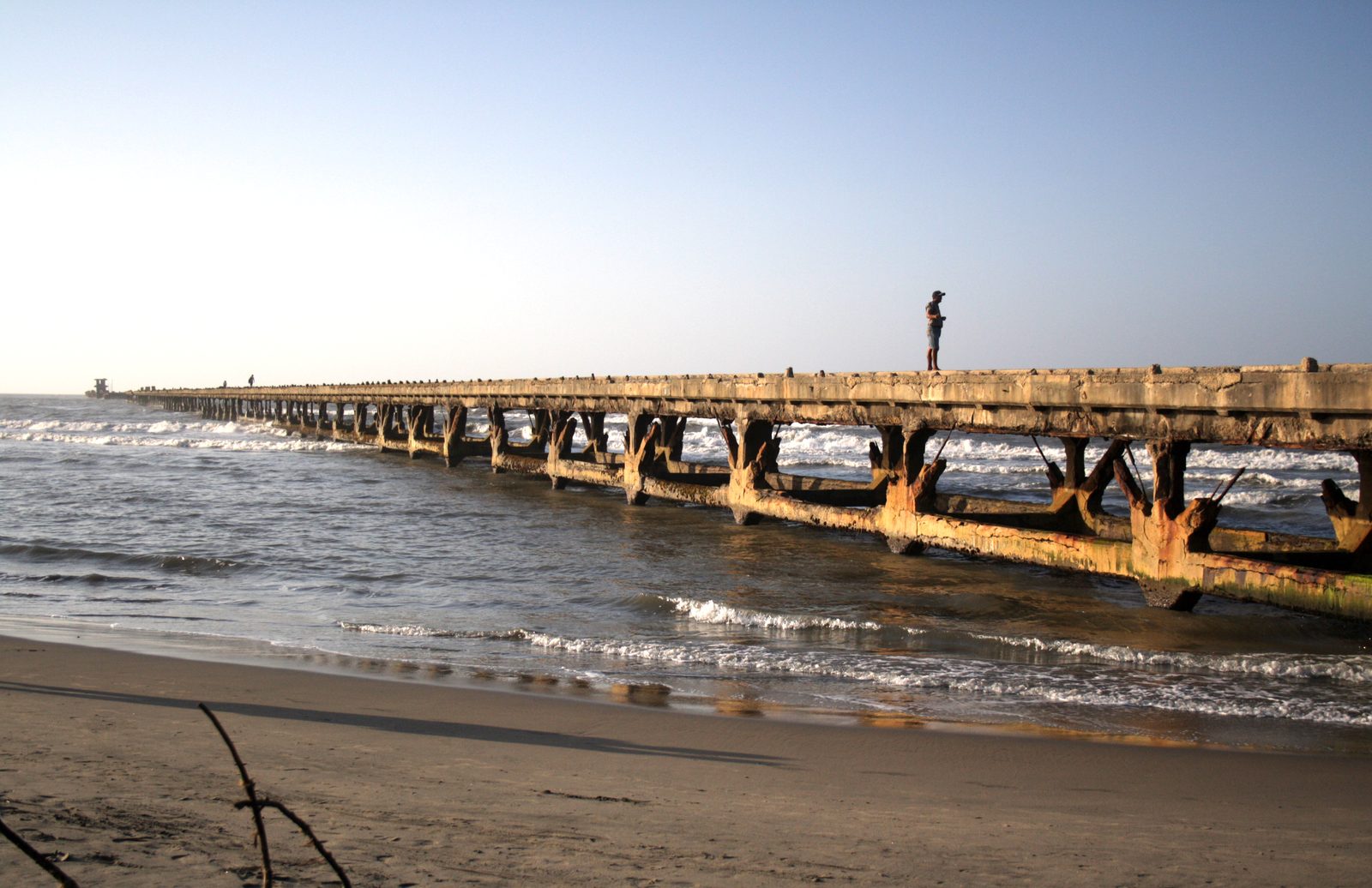
Its story is inseparable from Barranquilla's. In the late nineteenth century the mouth of the Magdalena River silted badly and ocean-going ships could not reach the city's river docks. The answer was to build out into deep water at Puerto Colombia. Construction of the pier began in 1888, directed by the Cuban engineer Francisco Javier Cisneros, and it was inaugurated in 1893. For decades it was counted among the longest piers in the world, and from 1893 until the 1930s this was the main maritime port of Colombia. A great deal of what arrived in the country by sea, people, machinery, mail, came across this dock first.
Su historia es inseparable de la de Barranquilla. A finales del siglo XIX la desembocadura del río Magdalena se llenó de sedimentos y los barcos de altura ya no podían llegar a los muelles fluviales de la ciudad. La solución fue construir mar adentro, en Puerto Colombia. La obra del muelle empezó en 1888, dirigida por el ingeniero cubano Francisco Javier Cisneros, y se inauguró en 1893. Durante décadas estuvo entre los muelles más largos del mundo, y desde 1893 hasta los años treinta este fue el principal puerto marítimo de Colombia. Buena parte de lo que llegaba al país por mar, personas, maquinaria, correo, pasaba primero por este embarcadero.
The sea eventually took most of it. After years of swells and little maintenance, a long final section of the pier collapsed in March 2009 and the structure was closed. What remained sat as a damaged heritage monument for years. Then, in August 2024, the restored pier reopened to the public as the Muelle 1888, with a walkable boardwalk and a cluster of food stalls, drawing thousands of visitors in its first weekend. It is now one of the most photographed spots on the Atlantic coast and an easy half-day from the city. We fold it into our day trips from Barranquilla.
El mar terminó por llevarse casi todo. Tras años de oleaje y poco mantenimiento, un largo tramo final del muelle se desplomó en marzo de 2009 y la estructura se cerró. Lo que quedó permaneció varios años como un monumento patrimonial dañado. Luego, en agosto de 2024, el muelle restaurado reabrió al público como el Muelle 1888, con un paseo peatonal y un grupo de locales de comida, y atrajo a miles de visitantes en su primer fin de semana. Hoy es uno de los lugares más fotografiados de la costa atlántica y un paseo fácil de medio día desde la ciudad. Lo incluimos en nuestros paseos de un día desde Barranquilla.
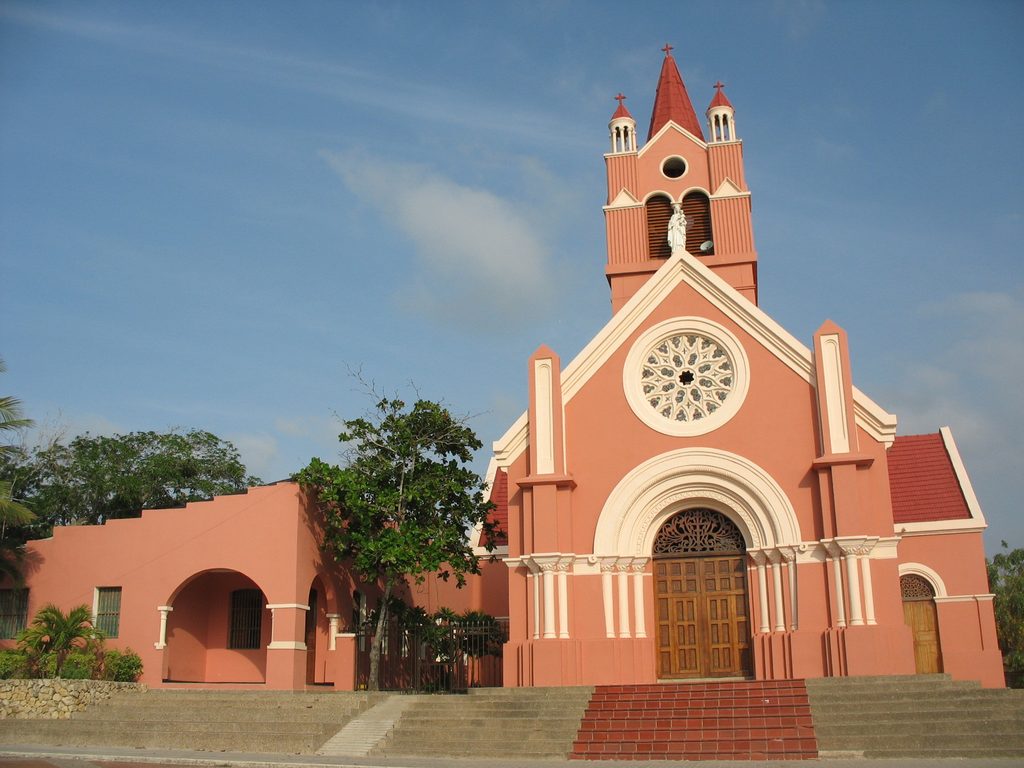
The Iglesia del Carmen on the main square in Puerto Colombia.La Iglesia del Carmen en la plaza principal de Puerto Colombia.Photo:Foto:Jdvillalobos · CC BY 3.0 · Wikimedia Commons
The town and its beachesEl pueblo y sus playas
Puerto Colombia has aged into an unusual thing: a historic port town that never got polished into a resort strip. The main square is modest, shaded, and real, with the Iglesia del Carmen at its edge. The old port and railway buildings still stand, a reminder of the line that once linked the dock to the city.
Puerto Colombia se volvió algo poco común: un pueblo portuario histórico que nunca se pulió hasta convertirse en un corredor de resorts. La plaza principal es sencilla, con sombra y de verdad, con la Iglesia del Carmen en una de sus orillas. Todavía siguen en pie los viejos edificios del puerto y del ferrocarril, recuerdo de la línea que en su momento unió el muelle con la ciudad.
The municipality has a long run of Caribbean beaches. Salgar is the main swimming beach, calm enough for families and busy with barranquilleros on weekends. Pradomar is the more developed stretch, with shaded booths, hammocks and seafood restaurants set right on the sand, and Sabanilla and Miramar round out the options. Above Salgar stands the Castillo de Salgar, a fort the Spanish built in 1848 on the ruins of an older colonial fort and declared a national cultural asset in 1998. For more beach and seaside outings, see the things to do section.
El municipio tiene una larga franja de playas caribeñas. Salgar es la playa principal de baño, lo bastante tranquila para las familias y muy concurrida por los barranquilleros los fines de semana. Pradomar es el tramo más desarrollado, con casetas con sombra, hamacas y restaurantes de mariscos montados sobre la misma arena, y Sabanilla y Miramar completan las opciones. Sobre Salgar se levanta el Castillo de Salgar, un fuerte que los españoles construyeron en 1848 sobre las ruinas de un fuerte colonial más antiguo y que fue declarado bien cultural de la Nación en 1998. Para más planes de playa y de mar, mira la sección de qué hacer.
On the food side, the beach booths do the basics well: grilled fish, patacones and arroz con coco from plastic tables a few steps from the water. It is not a dense dining scene, so if you want range, the city is close. Our guide to the best restaurants in Barranquilla covers the wider picture.
En lo gastronómico, las casetas de playa hacen bien lo básico: pescado frito, patacones y arroz con coco en mesas plásticas a pocos pasos del agua. No es una escena gastronómica densa, así que si buscas variedad, la ciudad queda cerca. Nuestra guía de los mejores restaurantes de Barranquilla cubre el panorama completo.
Living by the sea, commuting to the cityVivir junto al mar, trabajar en la ciudad
Over the last few years Puerto Colombia has turned into a real option for remote workers who want to live near the ocean for far less than Cartagena or Santa Marta would cost. It runs roughly estrato 2 to 4 depending on the sector, which makes it cheaper than most of Barranquilla proper. A one-bedroom near the water tends to land around COP 1,400,000 to 2,000,000 a month (USD $350 to $500 at 4.000:1), and a two-bedroom with a sea glimpse rarely climbs above COP 2,800,000 (USD $700). Houses come up too and are often negotiable. For the full method, see our housing and renting guide.
En los últimos años Puerto Colombia se ha vuelto una opción real para quienes trabajan remoto y quieren vivir cerca del mar por mucho menos de lo que costaría en Cartagena o Santa Marta. Va más o menos de estrato 2 a 4 según el sector, lo que lo hace más barato que casi toda Barranquilla. Un apartamento de una alcoba cerca del agua suele costar entre COP 1.400.000 y 2.000.000 al mes (USD $350 a $500 a 4.000:1), y uno de dos alcobas con vista parcial al mar rara vez pasa de COP 2.800.000 (USD $700). También salen casas, a menudo negociables. Para el método completo, mira nuestra guía de vivienda y arriendo.
Two practical notes. First, life here is slower and a lot of the bureaucracy still assumes you will drive into Barranquilla for serious errands, so plan a commute two or three days a week. Second, on the paperwork: most landlords want a local co-signer (codeudor) who owns property in the area, or an insurance-backed guarantee (poliza). On a passport that is harder to arrange than on a cedula, so many foreigners pay several months up front or rent through an agency instead. Internet is fine for remote work in most areas but varies by building, so always test the connection before you sign.
Dos notas prácticas. Primero, la vida aquí es más lenta y buena parte de la burocracia todavía da por hecho que vas a manejar hasta Barranquilla para las vueltas serias, así que cuenta con ir dos o tres días por semana. Segundo, sobre los papeles: la mayoría de los arrendadores piden un codeudor local con finca raíz en la zona, o una póliza de arrendamiento. Con pasaporte eso es más difícil de conseguir que con cédula, así que muchos extranjeros pagan varios meses por adelantado o arriendan a través de una agencia. El internet alcanza para trabajo remoto en casi todas las zonas, pero varía según el edificio, así que prueba siempre la conexión antes de firmar.
Who it is forPara quién es
Puerto Colombia is for you if:Puerto Colombia es para ti si:
You want to live near the ocean without paying Cartagena or Santa Marta prices.
You value slowness, space, and a sunset ritual over city density.
You work remotely and can commute into Barranquilla two or three days a week.
You like history and want to live a short walk from a restored nineteenth-century pier.
Quieres vivir cerca del mar sin pagar precios de Cartagena o Santa Marta.
Valoras la calma, el espacio y el ritual del atardecer por encima de la densidad de la ciudad.
Trabajas remoto y puedes ir a Barranquilla dos o tres días por semana.
Te gusta la historia y quieres vivir a pocos pasos de un muelle del siglo XIX restaurado.
Not for you if:No es para ti si:
You need to be in Barranquilla every single day.
You expect city-level density of restaurants, bars and nightlife at your door.
You want a newly built luxury apartment block with a full stack of amenities.
Necesitas estar en Barranquilla todos los días.
Esperas densidad de restaurantes, bares y vida nocturna al nivel de la ciudad a la vuelta de la esquina.
Quieres obra nueva de lujo con un montón de amenidades.
Puerto Colombia at a glancePuerto Colombia de un vistazo
Pier builtMuelle
1888 to 1893
DistanceDistancia
20 min west20 min al oeste
EstratoEstrato
2 to 42 a 4
1-BR rentArriendo 1 alcoba
COP 1.4M to 2MCOP 1,4M a 2M
Still have questions?¿Todavía tienes preguntas?
Catalina is our concierge. Ask her about visas, neighborhoods, healthcare, prices, anything Barranquilla. She answers in chat or WhatsApp, English or Spanish, free.Catalina es nuestra concierge. Pregúntale sobre visas, barrios, salud, precios, cualquier cosa de Barranquilla. Responde por chat o WhatsApp, en inglés o español, gratis.
Specific question while you read? Ask Catalina, the Barranquilla Guide concierge.¿Pregunta específica mientras lees? Pregúntale a Catalina, la concierge de Barranquilla Guide.Chat with Catalina ›Habla con Catalina ›
Not quite Barranquilla, not quite a beach town: a separate municipality with a deep history, a famous nineteenth-century pier, sea air, and a slower heartbeat than the city it helped build.
Ni del todo Barranquilla, ni del todo un pueblo de playa: un municipio aparte con una historia profunda, un famoso muelle del siglo XIX, brisa de mar y un pulso más lento que el de la ciudad que ayudó a construir.
Where Puerto Colombia sitsDónde queda Puerto Colombia
Puerto Colombia is technically its own municipality in the Atlantico department, not a Barranquilla neighborhood. But it sits so close, about 20 minutes west of the city by car, that most foreigners and relocators treat it as part of the same conversation. The drive runs out along the road past the Universidad del Norte, whose campus marks Kilometer 5 on the old route to the coast. By the time the apartment towers thin out, you are at the sea. To see how it fits against the inland barrios, start with our guide to Barranquilla's neighborhoods.
Puerto Colombia es, en rigor, un municipio propio del departamento del Atlántico, no un barrio de Barranquilla. Pero queda tan cerca, a unos 20 minutos al occidente de la ciudad en carro, que la mayoría de los extranjeros y quienes se mudan lo tratan como parte de la misma conversación. El camino sale por la vía que pasa frente a la Universidad del Norte, cuyo campus marca el Kilómetro 5 de la antigua ruta a la costa. Cuando las torres de apartamentos empiezan a escasear, ya estás frente al mar. Para ver cómo encaja con los barrios del interior, empieza por nuestra guía de los barrios de Barranquilla.
The pier that made Barranquilla possibleEl muelle que hizo posible a Barranquilla
Its story is inseparable from Barranquilla's. In the late nineteenth century the mouth of the Magdalena River silted badly and ocean-going ships could not reach the city's river docks. The answer was to build out into deep water at Puerto Colombia. Construction of the pier began in 1888, directed by the Cuban engineer Francisco Javier Cisneros, and it was inaugurated in 1893. For decades it was counted among the longest piers in the world, and from 1893 until the 1930s this was the main maritime port of Colombia. A great deal of what arrived in the country by sea, people, machinery, mail, came across this dock first.
Su historia es inseparable de la de Barranquilla. A finales del siglo XIX la desembocadura del río Magdalena se llenó de sedimentos y los barcos de altura ya no podían llegar a los muelles fluviales de la ciudad. La solución fue construir mar adentro, en Puerto Colombia. La obra del muelle empezó en 1888, dirigida por el ingeniero cubano Francisco Javier Cisneros, y se inauguró en 1893. Durante décadas estuvo entre los muelles más largos del mundo, y desde 1893 hasta los años treinta este fue el principal puerto marítimo de Colombia. Buena parte de lo que llegaba al país por mar, personas, maquinaria, correo, pasaba primero por este embarcadero.
The sea eventually took most of it. After years of swells and little maintenance, a long final section of the pier collapsed in March 2009 and the structure was closed. What remained sat as a damaged heritage monument for years. Then, in August 2024, the restored pier reopened to the public as the Muelle 1888, with a walkable boardwalk and a cluster of food stalls, drawing thousands of visitors in its first weekend. It is now one of the most photographed spots on the Atlantic coast and an easy half-day from the city. We fold it into our day trips from Barranquilla.
El mar terminó por llevarse casi todo. Tras años de oleaje y poco mantenimiento, un largo tramo final del muelle se desplomó en marzo de 2009 y la estructura se cerró. Lo que quedó permaneció varios años como un monumento patrimonial dañado. Luego, en agosto de 2024, el muelle restaurado reabrió al público como el Muelle 1888, con un paseo peatonal y un grupo de locales de comida, y atrajo a miles de visitantes en su primer fin de semana. Hoy es uno de los lugares más fotografiados de la costa atlántica y un paseo fácil de medio día desde la ciudad. Lo incluimos en nuestros paseos de un día desde Barranquilla.
The Iglesia del Carmen on the main square in Puerto Colombia.La Iglesia del Carmen en la plaza principal de Puerto Colombia.Photo:Foto:Jdvillalobos · CC BY 3.0 · Wikimedia Commons
The town and its beachesEl pueblo y sus playas
Puerto Colombia has aged into an unusual thing: a historic port town that never got polished into a resort strip. The main square is modest, shaded, and real, with the Iglesia del Carmen at its edge. The old port and railway buildings still stand, a reminder of the line that once linked the dock to the city.
Puerto Colombia se volvió algo poco común: un pueblo portuario histórico que nunca se pulió hasta convertirse en un corredor de resorts. La plaza principal es sencilla, con sombra y de verdad, con la Iglesia del Carmen en una de sus orillas. Todavía siguen en pie los viejos edificios del puerto y del ferrocarril, recuerdo de la línea que en su momento unió el muelle con la ciudad.
The municipality has a long run of Caribbean beaches. Salgar is the main swimming beach, calm enough for families and busy with barranquilleros on weekends. Pradomar is the more developed stretch, with shaded booths, hammocks and seafood restaurants set right on the sand, and Sabanilla and Miramar round out the options. Above Salgar stands the Castillo de Salgar, a fort the Spanish built in 1848 on the ruins of an older colonial fort and declared a national cultural asset in 1998. For more beach and seaside outings, see the things to do section.
El municipio tiene una larga franja de playas caribeñas. Salgar es la playa principal de baño, lo bastante tranquila para las familias y muy concurrida por los barranquilleros los fines de semana. Pradomar es el tramo más desarrollado, con casetas con sombra, hamacas y restaurantes de mariscos montados sobre la misma arena, y Sabanilla y Miramar completan las opciones. Sobre Salgar se levanta el Castillo de Salgar, un fuerte que los españoles construyeron en 1848 sobre las ruinas de un fuerte colonial más antiguo y que fue declarado bien cultural de la Nación en 1998. Para más planes de playa y de mar, mira la sección de qué hacer.
On the food side, the beach booths do the basics well: grilled fish, patacones and arroz con coco from plastic tables a few steps from the water. It is not a dense dining scene, so if you want range, the city is close. Our guide to the best restaurants in Barranquilla covers the wider picture.
En lo gastronómico, las casetas de playa hacen bien lo básico: pescado frito, patacones y arroz con coco en mesas plásticas a pocos pasos del agua. No es una escena gastronómica densa, así que si buscas variedad, la ciudad queda cerca. Nuestra guía de los mejores restaurantes de Barranquilla cubre el panorama completo.
Living by the sea, commuting to the cityVivir junto al mar, trabajar en la ciudad
Over the last few years Puerto Colombia has turned into a real option for remote workers who want to live near the ocean for far less than Cartagena or Santa Marta would cost. It runs roughly estrato 2 to 4 depending on the sector, which makes it cheaper than most of Barranquilla proper. A one-bedroom near the water tends to land around COP 1,400,000 to 2,000,000 a month (USD $350 to $500 at 4.000:1), and a two-bedroom with a sea glimpse rarely climbs above COP 2,800,000 (USD $700). Houses come up too and are often negotiable. For the full method, see our housing and renting guide.
En los últimos años Puerto Colombia se ha vuelto una opción real para quienes trabajan remoto y quieren vivir cerca del mar por mucho menos de lo que costaría en Cartagena o Santa Marta. Va más o menos de estrato 2 a 4 según el sector, lo que lo hace más barato que casi toda Barranquilla. Un apartamento de una alcoba cerca del agua suele costar entre COP 1.400.000 y 2.000.000 al mes (USD $350 a $500 a 4.000:1), y uno de dos alcobas con vista parcial al mar rara vez pasa de COP 2.800.000 (USD $700). También salen casas, a menudo negociables. Para el método completo, mira nuestra guía de vivienda y arriendo.
Two practical notes. First, life here is slower and a lot of the bureaucracy still assumes you will drive into Barranquilla for serious errands, so plan a commute two or three days a week. Second, on the paperwork: most landlords want a local co-signer (codeudor) who owns property in the area, or an insurance-backed guarantee (poliza). On a passport that is harder to arrange than on a cedula, so many foreigners pay several months up front or rent through an agency instead. Internet is fine for remote work in most areas but varies by building, so always test the connection before you sign.
Dos notas prácticas. Primero, la vida aquí es más lenta y buena parte de la burocracia todavía da por hecho que vas a manejar hasta Barranquilla para las vueltas serias, así que cuenta con ir dos o tres días por semana. Segundo, sobre los papeles: la mayoría de los arrendadores piden un codeudor local con finca raíz en la zona, o una póliza de arrendamiento. Con pasaporte eso es más difícil de conseguir que con cédula, así que muchos extranjeros pagan varios meses por adelantado o arriendan a través de una agencia. El internet alcanza para trabajo remoto en casi todas las zonas, pero varía según el edificio, así que prueba siempre la conexión antes de firmar.
Who it is forPara quién es
Puerto Colombia is for you if:Puerto Colombia es para ti si:
You want to live near the ocean without paying Cartagena or Santa Marta prices.
You value slowness, space, and a sunset ritual over city density.
You work remotely and can commute into Barranquilla two or three days a week.
You like history and want to live a short walk from a restored nineteenth-century pier.
Quieres vivir cerca del mar sin pagar precios de Cartagena o Santa Marta.
Valoras la calma, el espacio y el ritual del atardecer por encima de la densidad de la ciudad.
Trabajas remoto y puedes ir a Barranquilla dos o tres días por semana.
Te gusta la historia y quieres vivir a pocos pasos de un muelle del siglo XIX restaurado.
Not for you if:No es para ti si:
You need to be in Barranquilla every single day.
You expect city-level density of restaurants, bars and nightlife at your door.
You want a newly built luxury apartment block with a full stack of amenities.
Necesitas estar en Barranquilla todos los días.
Esperas densidad de restaurantes, bares y vida nocturna al nivel de la ciudad a la vuelta de la esquina.
Quieres obra nueva de lujo con un montón de amenidades.
Puerto Colombia at a glancePuerto Colombia de un vistazo
Pier builtMuelle
1888 to 1893
DistanceDistancia
20 min west20 min al oeste
EstratoEstrato
2 to 42 a 4
1-BR rentArriendo 1 alcoba
COP 1.4M to 2MCOP 1,4M a 2M
Still have questions?¿Todavía tienes preguntas?
Catalina is our concierge. Ask her about visas, neighborhoods, healthcare, prices, anything Barranquilla. She answers in chat or WhatsApp, English or Spanish, free.Catalina es nuestra concierge. Pregúntale sobre visas, barrios, salud, precios, cualquier cosa de Barranquilla. Responde por chat o WhatsApp, en inglés o español, gratis.
Get the guide in your inboxRecibe la guía en tu correo
Weekly picks, new guides, and things worth knowing about Barranquilla. No noise, no news feed. Just the useful stuff.Cada semana: recomendaciones, guías nuevas y lo que vale la pena saber de Barranquilla. Sin ruido, sin feed de noticias. Solo lo útil.