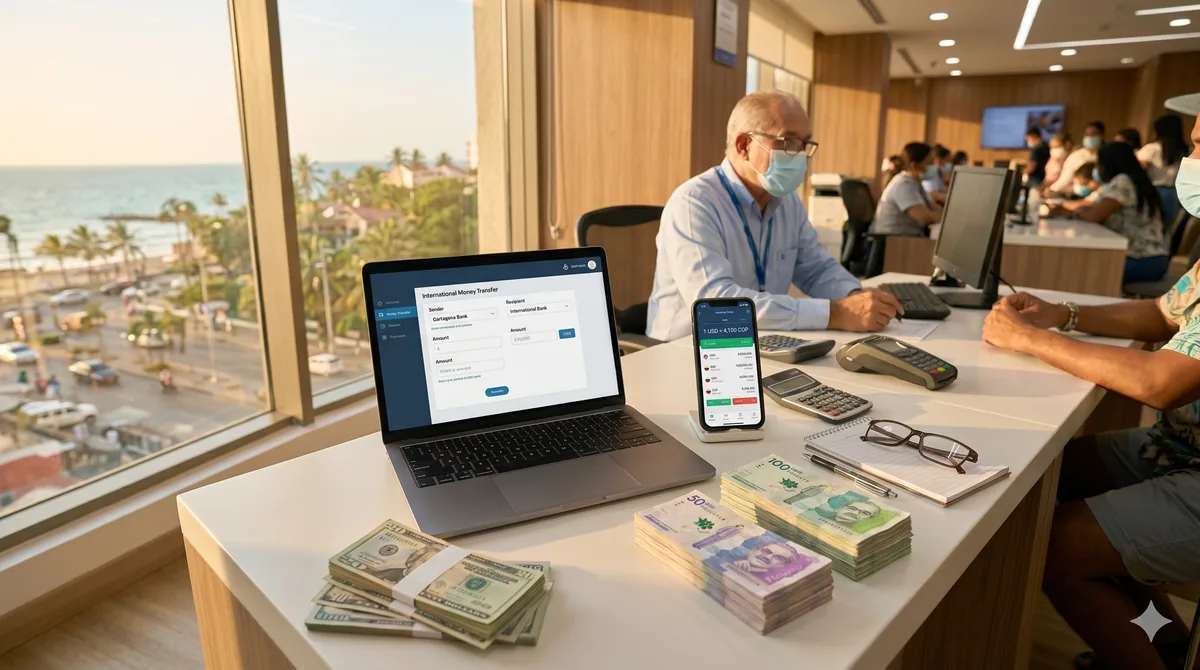

Whether you are moving COP 2.000.000 (USD 500 at 4.000:1) for next month's rent or COP 1.000.000.000 (USD 250.000) to buy an apartment, the path you pick and the paperwork you file change how much money you keep and how much hassle you face. This is the national playbook for getting money into Colombia: the services that work, the exchange-rate reality, the small tax that nicks every transfer, the cash-declaration rule at customs, and the one filing that lets investors get their money back out later. Informational only, not financial advice.
The landscape
Money moving into Colombia falls into a handful of paths: international bank wires (SWIFT), fintech transfer apps like Wise, remittance networks like Western Union and MoneyGram, physical cash you carry in, casas de cambio where you swap dollars for pesos, and ATM withdrawals once you land. Each has a different cost, speed, and legal footprint. The right choice depends on three things: how much you are sending, whether the money is for living expenses or an investment, and whether you are already a Colombian tax resident.
None of this is Barranquilla-specific, the rules are national, set by Banco de la República and DIAN, and they apply the same whether the money lands in a Bancolombia account in El Prado or a Davivienda branch in Bogotá. What changes city to city is which casas de cambio and bank branches are nearby, and that is covered below for the Caribbean coast.
Fast answer: for rent and living expenses, use Wise. For an investment-sized transfer, wire from your home bank into a Colombian bank in your own name and file Formulario No. 4 with Banco de la República through that bank within the deadline. Skip Western Union unless someone needs cash in hand today.
The exchange-rate reality, and where you lose money
The reference rate is the TRM, the Tasa Representativa del Mercado, the official peso-to-dollar rate published every business day by the Superintendencia Financiera. Through 2026 it has hovered around COP 4.000 per USD 1, which is the rate this guide uses for conversions. Every legitimate exchange in Colombia references the TRM, but almost nobody gives you exactly the TRM.
Where you lose money is the spread, the gap between the real mid-market rate and the rate you actually get. A traditional bank converting your dollars can quietly take 2 to 4 percent. A casa de cambio runs about 1 to 2 percent off the TRM. A fintech like Wise uses the mid-market rate and charges a transparent fee of roughly 0.4 to 0.7 percent instead of hiding the cost in a bad rate. On a COP 40.000.000 (USD 10.000) transfer, the difference between a 3 percent bank spread and a sub-1 percent fintech fee is well over COP 800.000 (USD 200). It compounds every month you pay rent, so the service you default to matters.
One more reason peso amounts wander: a transfer that takes three business days lands at whatever the TRM is on the day it settles, not the day you started it. Do not be surprised if the pesos that arrive differ slightly from your back-of-napkin math.
Everyday transfers for rent and living expenses
These are the tools expats and remote workers use for rent, groceries, and day-to-day life. Direct deposits to a Colombian account (Bancolombia, Nequi, Davivienda, BBVA) usually land in hours, not days.
Wise and similar fintechs
Wise is the default for nearly everyone. It uses the real mid-market rate with a transparent fee of roughly 0.4 to 0.7 percent depending on the currency pair. A USD 1.000 (COP 4.000.000) transfer to a Bancolombia account typically costs the equivalent of COP 16.000 to COP 28.000 (USD 4 to 7) and arrives the same day. You can hold a multi-currency balance, get a debit card that works at Colombian ATMs, and spend directly in pesos without your home bank's foreign-exchange markup. Revolut is a reasonable second choice if you are coming from the UK or EU, and Remitly is purpose-built for one-way transfers from the US, Canada, UK, or Australia into a Colombian account. All three verify your identity once with a passport photo and are usable within a day.
Western Union, MoneyGram and remittances
Remittance networks are still useful for one case: smaller amounts where the recipient has no Colombian bank account, or an emergency where someone has to walk in and pick up pesos the same day. Pickup points are everywhere in Barranquilla, Éxito supermarkets, Giros y Finanzas branches, dedicated counters in most malls, and corner agents under the Efecty brand. The catch is the cost: foreign-exchange markup runs 2 to 4 percent, meaningfully worse than Wise. Only use remittances when speed and cash pickup outweigh the cost.
ATM withdrawals on arrival
The fastest way to get pesos in your hand the day you land is an ATM. A debit card from a low-fee account (Wise, Revolut, Charles Schate-style no-fee checking, or whatever your home bank offers) will dispense pesos at the TRM-linked network rate. Watch for two charges: the Colombian bank's per-withdrawal fee (often COP 20.000 to COP 30.000, roughly USD 5 to 8) and the dreaded "dynamic currency conversion" screen. Always choose to be charged in pesos (COP), never in your home currency, the "convenience" conversion bakes in a 3 to 7 percent markup. Bancolombia and Davivienda ATMs are common across the city; airport ATMs at Ernesto Cortissoz (BAQ) in Soledad work fine but you will pass plenty more in town. Daily withdrawal caps mean ATMs are for topping up, not for moving real capital.
Large transfers and bank wires
Above roughly USD 10.000 (COP 40.000.000), consumer apps start to hit daily and monthly limits, and Colombian authorities start paying attention. The rules here are not about paying tax, they are about proving where the money came from and registering the operation with the right regulator.
International bank wire (SWIFT)
The traditional path for investment-sized money. You initiate a wire from your home bank to your Colombian bank account. Bancolombia, BBVA Colombia, Davivienda, and Itaú all accept incoming SWIFT wires from abroad. Typical all-in cost is a flat sending fee of around COP 100.000 to COP 200.000 (USD 25 to 50) from your home bank, plus a 0.5 to 1.5 percent foreign-exchange markup on the Colombian side. It is slower than Wise (2 to 5 business days) but supports any amount.
The key requirement: the Colombian bank receiving the money acts as your Intermediario del Mercado Cambiario (IMC), the authorized foreign-exchange intermediary. When the wire lands, the bank will ask you to complete a declaración de cambio, either the form for a personal or living-expenses transfer or Formulario No. 4 for an investment transfer. You must do this. Without the form, the bank legally cannot release the funds into your account.
Wise for large transfers
Wise does handle transfers well above USD 10.000 (the verified-account limit in most corridors runs into the hundreds of thousands or higher per transfer). Your home bank sees it as a payment to Wise's local entity, then Wise sends pesos onward to your Colombian account. For pure living-expense money this is cheaper than a SWIFT wire. But for investment money where you want Banco de la República registration, a SWIFT wire directly into your own name at a Colombian bank is cleaner paperwork: one sender, one beneficiary, one foreign-exchange operation, and the receiving bank can process Formulario No. 4 on the spot.
Registering foreign investment with Banco de la República
This is the big one for buyers and investors, and the most expensive thing people get wrong. If the money is to buy Colombian property, start a business, acquire Colombian securities, or make any other investment, you must register the inbound transfer with Banco de la República using the foreign-investment declaration, Formulario No. 4. The filing is done through your IMC (your Colombian bank) at the time of the foreign-exchange operation, and the bank submits it electronically. The rules live in the central bank's Estatuto Cambiario (Circular DCIN-83), available on the Banco de la República site.
Why this matters: registration is what lets you legally repatriate the original capital and any gains later. Suppose you buy a Barranquilla apartment for COP 600.000.000 (USD 150.000), hold it five years, sell it for COP 880.000.000 (USD 220.000), and never registered the inbound transfer. Colombian law treats that COP 600.000.000 as if it never legally entered the country. You can still get the money out, but the process is slow, expensive, and involves retroactive filings with penalties. Confirm with your bank before the wire arrives that they will process the declaración de cambio as a Formulario No. 4 at the moment the funds land. That single step preserves your right to take both your capital and your profit back out.
Bringing cash and the declaration rule
Carrying cash in is legal, but heavily regulated once you cross a threshold.
- Under the USD 10.000 equivalent (about COP 40.000.000): no declaration needed at customs. Put it away and walk through.
- USD 10.000 or more (in any currency, combined): you must declare it to DIAN (customs) on arrival, on the equipaje and cash declaration form. Not declaring is a currency offense. The penalty for non-declaration is typically around 30 percent of the undeclared amount plus a confiscation risk. Declaring is free and takes a few minutes.
Once the cash is in Colombia, exchange it at an authorized casa de cambio rather than on the street. Reliable national chains with coast branches include Titán Intercontinental and Giros y Finanzas, and there are booths at Ernesto Cortissoz airport (BAQ), though airport rates are usually the worst in the city. Licensed casas typically run 1 to 2 percent off the TRM. Avoid unlicensed street money-changers entirely. Practical note: carrying more than the USD 20.000 (COP 80.000.000) equivalent in cash, even when properly declared, will draw extra questioning from DIAN about the source of the funds, so have bank statements ready.
On safety: carrying large amounts of physical cash through any city, Barranquilla included, is the riskiest way to move money. It cannot be reversed if lost or taken, it does not build the paper trail a bank deposit does, and it does nothing to register an investment. Use cash for arrival pocket money and small needs, not as your main channel.
The 4x1000 tax and the exempt account
Colombia charges a small tax on most money leaving a bank account, the gravamen a los movimientos financieros (GMF), known to everyone as the 4x1000, four pesos for every thousand, or 0.4 percent. It applies to withdrawals, transfers between different owners, and some card payments. On a COP 4.000.000 (USD 1.000) movement that is COP 16.000 (USD 4), small per transaction but it adds up across a month of rent, transfers, and bill payments.
The relief: every individual is entitled to designate one account as exempt from the 4x1000 up to a monthly cap (set in UVT, the figure is in the tens of millions of pesos per month for 2026, far above normal household use). Most residents mark their main Bancolombia or Davivienda account as exenta del GMF. Ask for this when you open the account, or request it afterward at a branch. Skipping this step is one of the most common quiet money-losers for new arrivals, the bank will not set it up automatically.
Receiving money in Colombia
To receive transfers efficiently you want a Colombian account. The two workhorses are Bancolombia (the largest bank, branches and ATMs everywhere on the coast) and its mobile-first sibling Nequi, which is fast to open and ideal for receiving fintech and peer transfers. Davivienda and BBVA are solid alternatives, and Daviplata is Davivienda's lightweight mobile wallet. Wise, Remitly, and Revolut can deposit pesos directly into a Bancolombia or Nequi account, and most landlords accept a plain Bancolombia transfer.
Without a Colombian account you can still receive money, but inefficiently: a Western Union pickup, or a wire to a landlord's account. Having your own account makes everything simpler and is worth setting up early. For the full walkthrough on opening accounts as a foreigner, the cards to ask for, and how the coast banks compare, see our Barranquilla banking and money guide.
Fees and timing at a glance
- Wise and similar fintechs: roughly 0.4 to 0.7 percent, minutes to same-day. Best for rent and living expenses.
- SWIFT bank wire: about COP 100.000 to COP 200.000 (USD 25 to 50) flat plus 0.5 to 1.5 percent foreign-exchange, 2 to 5 business days. Best for investment-sized transfers and anything needing Formulario No. 4.
- Western Union and MoneyGram: 2 to 4 percent, minutes. Best only for cash pickup by an unbanked recipient.
- Casa de cambio (cash): 1 to 2 percent off the TRM, instant. Best for converting dollars you already carry.
- ATM withdrawal: network rate plus a per-withdrawal fee around COP 20.000 to COP 30.000 (USD 5 to 8), instant. Best for topping up, capped daily.
Common mistakes
- Wiring money for a property purchase without filing Formulario No. 4. The single most expensive mistake. Always confirm your Colombian bank will process the declaración de cambio as an investment at the time of the incoming wire.
- Carrying the USD 10.000 equivalent or more in cash without declaring it. The penalty is up to about 30 percent of the undeclared amount. Declaring is free and takes minutes.
- Relying on Western Union for regular rent. You leave 2 to 4 percent on the table every month for no gain over Wise.
- Letting your home bank convert dollars to pesos before sending. Home banks routinely take a 2 to 4 percent foreign-exchange markup plus a wire fee. Send dollars and let a local IMC or a fintech do the conversion near the real rate.
- Choosing the ATM's "charge in my home currency" option. That dynamic currency conversion adds 3 to 7 percent. Always pick pesos.
- Never marking an account as 4x1000 exempt. Every resident gets one exempt account. Ask for it.
- Ignoring the tax-residency trigger. Once your days in Colombia cross the residency threshold you owe DIAN a declaration on worldwide income. See our Colombia tax residency guide.
FAQ
Is there a limit to how much money I can bring into Colombia? No cap. Above the USD 10.000 equivalent you must declare it (cash) or channel it through an IMC (bank transfer). Beyond that, the only practical limits are those set by your own bank and the service you use.
Do I pay tax just for bringing money in? Not on the transfer itself. You pay tax on Colombian-source income and, once you become a tax resident, on worldwide income going forward. Moving capital in is not a taxable event. Details in our tax residency guide.
What is the difference between Formulario No. 4 and the personal-transfer form? Formulario No. 4 registers an inbound transfer as foreign investment, preserving repatriation rights for both the principal and future gains. The personal-transfer declaration covers living expenses, salary remittances, and gifts. Your Colombian bank will ask which applies when the money lands.
Can I pay rent from abroad without a Colombian account? Yes, but inefficiently, via a fintech's peso rail to the landlord's Bancolombia account, a Western Union pickup, or a wire. Having your own Colombian account makes it far simpler.
Why do the peso amounts I see change daily? Because the TRM, the official peso-to-dollar reference, is republished every business day. A transfer that settles three days later lands at a different TRM than the day you sent it.
Is it legal to pay Colombian vendors in dollars? Pesos are the only legal tender. A vendor is not required to accept dollars, though some short-term-rental hosts will informally. For anything routine, convert to pesos through a bank or casa de cambio.
How do I prove "source of funds" to my Colombian bank? Bring three months of home-country bank statements, an employer letter or tax return if relevant, and, for property or a business, the purchase contract or investment agreement. Banks prefer PDFs emailed directly from the originating institution.
Further reading on this site
Banking and money in Barranquilla, the complete guide
Colombia tax residency, the 2026 guide
Understanding Colombia's estrato system
Informational only, not financial, tax, or legal advice. Fees, thresholds, exchange rates, and tax figures change; always confirm current rules with your bank, a licensed Colombian accountant, and the official sources, Banco de la República and DIAN. Last review: May 2026.
Still have questions?¿Todavía tienes preguntas?
Catalina is our concierge. Ask her about visas, neighborhoods, healthcare, prices, anything Barranquilla. She answers in chat or WhatsApp, English or Spanish, free.Catalina es nuestra concierge. Pregúntale sobre visas, barrios, salud, precios, cualquier cosa de Barranquilla. Responde por chat o WhatsApp, en inglés o español, gratis.
Chat with Catalina ›Habla con Catalina ›